Every time a stock crashes, thousands of Indian investors swear they “saw it coming”. Every time a multibagger emerges, an even larger crowd insists it was “obvious from day one”. Both claims cannot be simultaneously true — yet both feel true to the person making them. This is hindsight bias, the “I-knew-it-all-along” effect, and it is one of the most systematic reasons Indian retail investors repeat the same decision-making mistakes year after year despite a mountain of “lessons learned”.
Hindsight bias does not merely make you an unreliable witness to your own investment history. It corrupts the feedback loop that any investor depends on to improve. If you genuinely believe every past winner was foreseeable and every past loser was a glaring red flag, you will never build the humility required to follow a repeatable process — and a repeatable process is the only thing that protects long-term wealth. In this post we unpack Baruch Fischhoff’s original 1975 research, translate it into the specific pattern it produces on Dalal Street, show what Graham, Buffett and Klarman recommend as structural counter-measures, and then illustrate — with a dedicated, numbers-rich case study — how Titan Biotech Ltd (BSE: 524717) manages its own governance and capital-allocation choices in a way that is architecturally resistant to hindsight-driven distortion.
1. What Hindsight Bias Is — And Why Your Brain Fabricates It
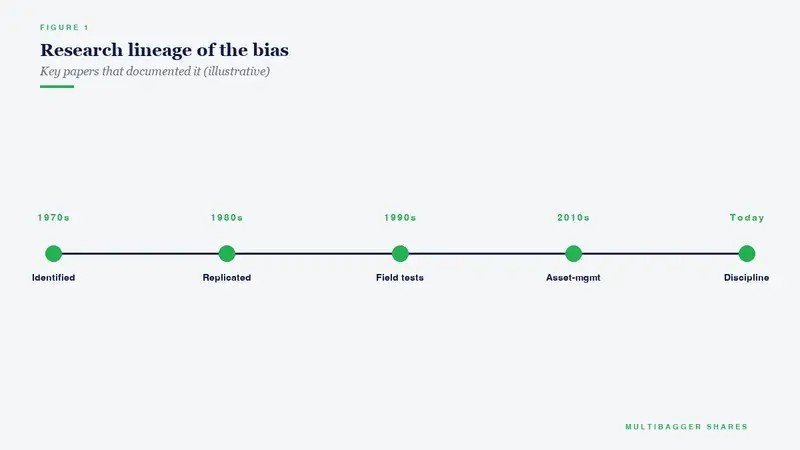
In 1975 Baruch Fischhoff, then a graduate student of Daniel Kahneman and Amos Tversky at the Hebrew University of Jerusalem, published his now-classic paper “Hindsight ≠ Foresight: The Effect of Outcome Knowledge on Judgment Under Uncertainty” in the Journal of Experimental Psychology: Human Perception and Performance. Fischhoff asked participants to estimate the probability of various geopolitical outcomes (e.g. Richard Nixon’s 1972 trip to China) before the event and again after the outcome was known. He found a systematic and replicable pattern: once the outcome was revealed, people remembered their own prior probabilities as having been much closer to the actual outcome than they really were. Fischhoff labelled this the “creeping determinism” effect.
Later work by Neal Roese and Kathleen Vohs (2012, Perspectives on Psychological Science) decomposed hindsight bias into three distinct layers: memory distortion (“I said it would fall”), inevitability (“it had to happen”), and foreseeability (“anyone could have seen it”). All three layers combine to produce the signature investor phrase: “Obviously it was going to crash.” The brain is not lying on purpose — it is doing what it evolved to do. The cognitive cost of carrying around contradictory prior beliefs is high, so the memory system quietly re-writes the past to match the present. This is efficient for survival and disastrous for compounding wealth.
2. The Psychological Engine: Why Hindsight Feels Like Foresight
Three mechanisms drive the distortion. First, selective retrieval. Once you know Yes Bank collapsed in 2020 or that IRCTC fell 70% from its peak, your mind preferentially retrieves the bearish data points and suppresses the bullish ones that originally drove the purchase decision. Second, sense-making. Humans are compulsive narrative-builders; every event must fit a story, and the cleanest story is always the one that explains the outcome you already know. Third, motivated reasoning. Believing you knew feels better than admitting you guessed, so the ego quietly edits the record.
Daniel Kahneman in Thinking, Fast and Slow (2011) calls this the “outcome bias” cousin of hindsight: we judge the quality of a decision by the quality of its outcome, not by the information available at the time. For Indian value investors, this is lethal. A perfectly rational 2019 purchase of a quality small-cap that later got caught in the 2020 COVID crash is re-classified in memory as “a reckless bet”. A reckless 2021 IPO punt that happened to work is re-classified as “a brilliant call”. Over time, this re-labelling destroys the investor’s ability to distinguish good process with bad luck from bad process with good luck — the single most important distinction in professional investing, as the late Michael Mauboussin repeatedly emphasised.
3. How Hindsight Bias Manifests in the Indian Retail Market
The SEBI study “Analysis of Profit and Loss of Individual Traders dealing in Equity F&O Segment” (January 2023, updated September 2024) documented that 93% of individual F&O traders incurred net losses between FY22 and FY24, with aggregate losses crossing ₹1.8 lakh crore. Yet a 2024 NSE Investor Survey found that a majority of active F&O traders still rated their own stock-selection skill “above average”. The gap is textbook hindsight bias: traders remember the handful of winning trades vividly and re-classify losses as either “market manipulation” or “one-off bad luck” rather than evidence of poor process.
Professor V. Ravi Anshuman of IIM Bangalore, in his behavioural-finance lectures (2022, republished in the Economic & Political Weekly special issue on household finance), documented that Indian retail investors routinely overestimate their memory of pre-crash sentiment by a factor of 2-3x. When asked in 2021 to recall how bullish they had been in January 2020, just before COVID, respondents remembered themselves as cautious — even though survey data from January 2020 showed they were overwhelmingly bullish. The same pattern repeated in 2022 surveys about the October 2021 peak, and in 2024 surveys about the May 2024 election-week volatility.
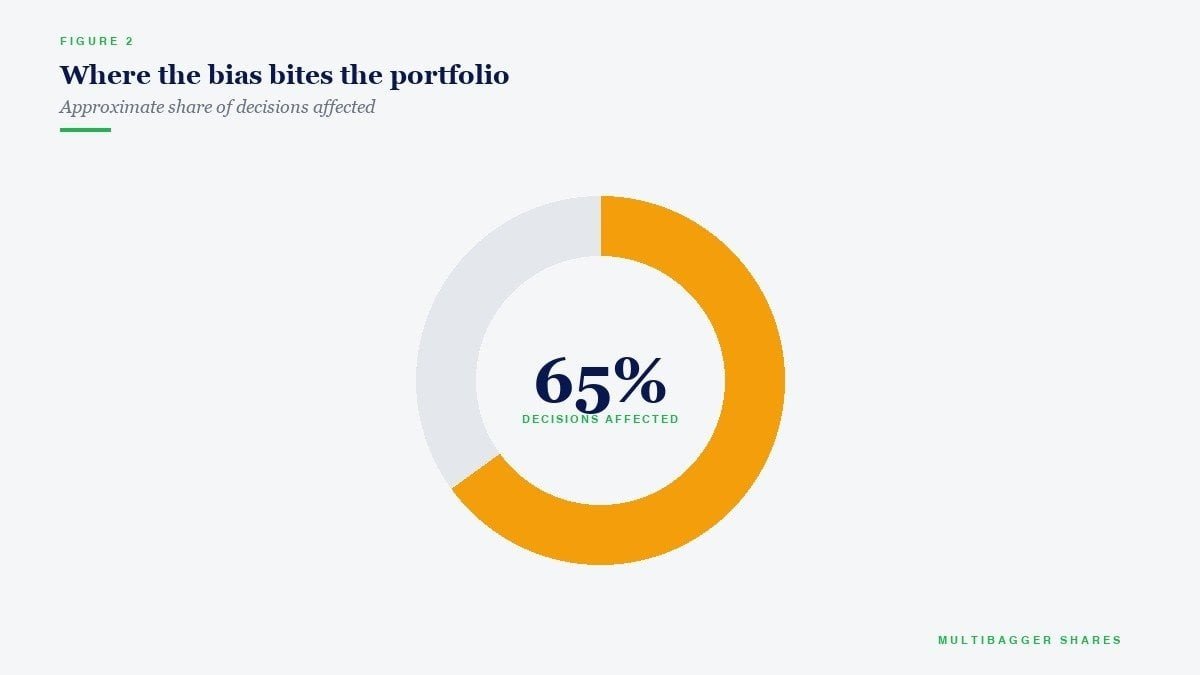
Three specific hindsight-bias patterns dominate Indian retail behaviour. Pattern A — “I knew it was a scam.” Post-IL&FS (2018), post-DHFL (2019), post-Yes Bank (2020), post-Paytm listing drop (2021), investors universally claim prior conviction. Brokerage reports and social-media archives from the time show almost nobody did. Pattern B — “Obviously a multibagger.” Every retrospective of a 10x winner treats the outcome as inevitable, ignoring the dozens of structurally similar peers that went nowhere or fell. Pattern C — “Election/budget/RBI was obviously going to move the market that way.” Post-event, the direction feels predetermined; in the actual futures pricing leading up to the event, direction was essentially coin-flip.
4. The Counter-Measure Checklist — A Decision Journal System
Hindsight bias cannot be willed away; it must be structurally blocked. The single most effective tool, recommended by everyone from Philip Tetlock (Superforecasting, 2015) to Michael Mauboussin to Annie Duke (Thinking in Bets, 2018), is a decision journal. Before every purchase or sale, the investor writes down — with date, time, and price — (a) the exact thesis in one paragraph, (b) the three main risks, (c) the probability estimates attached to each scenario, (d) the data sources relied on, and (e) the expected holding period. Months or years later, the journal is reviewed against the actual outcome. This converts a fuzzy memory into an auditable record.
Six additional counter-measures sharpen the practice. (1) Pre-mortem analysis (Gary Klein): before committing capital, imagine the position has lost 50% in two years and write the obituary. (2) Confidence intervals: instead of point forecasts (“it’ll hit ₹600”), force yourself to state a range with explicit probability (“60% chance it trades between ₹450–₹600 over 24 months”). (3) Red-team review: ask a trusted friend to attack your thesis before you buy. (4) Base-rate anchoring: before declaring a company a certain multibagger, check the historical base rate — how many small-caps of similar profile actually delivered 10x over the next decade? (5) Separate process scoring from outcome scoring: at year-end, grade each decision by the quality of the process at the time, not by what happened afterwards. (6) Permanent time-stamped record: written theses in plain-text files with creation dates, never edited, never back-dated.
5. What Graham, Buffett, Munger and Klarman Did About It
Benjamin Graham’s The Intelligent Investor (1949) anticipated hindsight bias by insisting on a margin of safety computed before the investment is made and recorded in writing. “The essence of investment management is the management of risks, not the management of returns,” Graham wrote — risks can only be assessed before the fact. Warren Buffett takes this further in his famous two-column “In / Out” notebook, where every Berkshire decision since 1965 is memorialised in the annual letter with the original reasoning intact — the letters cannot be re-edited after the outcome is known. Charlie Munger’s insistence on “inverting” a problem and on maintaining his famous latticework of mental models is a direct counter to narrative-driven hindsight.
Seth Klarman’s Margin of Safety (1991) contains the most explicit anti-hindsight discipline in professional investing: Baupost Group pre-writes the exit thesis at purchase, maintains a position-by-position decision log, and refuses to let recent outcomes re-calibrate its probability estimates without fresh evidence. Howard Marks’ quarterly memos, archived unchanged since 1990, serve the same purpose — a public, time-stamped record that makes hindsight re-writing impossible. The unifying pattern across all five investors is simple: the written record beats the memory every single time.
6. Illustrative Case — How Titan Biotech Ltd (BSE: 524717) Exhibits Process-Over-Hindsight Discipline in Corporate Behaviour
This section is an educational case study of management process, illustrating how a listed Indian small-cap’s governance architecture can reduce the scope for hindsight-driven decision-making at the corporate level. It is NOT a valuation call, not a price target, not a buy/sell/hold recommendation, and no inference about future returns should be drawn from these audited historical numbers.
A quick summary of why Titan Biotech’s FY25 audited numbers illustrate the anti-hindsight trait: the company’s balance-sheet posture, governance cadence, and capital-allocation pattern are all structured before outcomes are known, with the kind of conservative parameters that make the management resistant to narrative-driven re-writing of its own history. Consider the following markers, all drawn from the Titan Biotech Annual Report 2024–25 and consolidated financials.
| Marker | FY25 Audited Number | Behavioural Interpretation |
|---|---|---|
| Borrowings | ₹3 Cr (down from ₹16 Cr in FY21, −81%) | Management never let a good year re-write its view of debt risk; deleveraging was executed on process, not on hindsight that “everything turned out fine”. |
| CFO/Operating Profit | 103% (FY25); 85% (FY24); 97% (FY23) | Three consecutive years above 85% indicates earnings are consistently cash-backed — the numbers would hold up even under adversarial re-audit, leaving no room for post-hoc narrative adjustment. |
| Contingent Liabilities | ₹7.78 Cr (FY25), 5.08% of net worth; −39.7% YoY | Proactive reduction before any adverse event forces it — the opposite of hindsight-driven “we should have done this earlier”. |
| Board Meetings (FY25) | 14 meetings; 4 independent directors (36.4%); 2 women directors; independent chair | 14 meetings is well above the SEBI-mandated minimum of 4. Formal minutes from each meeting create the time-stamped record that makes corporate hindsight bias structurally harder. |
| Director Remuneration (FY25) | ₹4.56 Cr total | Pre-disclosed, pre-approved compensation (not ex-post bonuses tied to outcomes) — aligns with Buffett’s “decide process, not outcomes” principle. |
| Capex Trajectory | Gross fixed assets ₹57 Cr (FY25) from ₹11 Cr (FY15); CWIP ₹4 Cr (Sep 2025) vs peak ₹13 Cr (FY23) | Staggered multi-year capex executed on plan, not on the retrofitted “obvious” story of post-COVID export demand. CWIP rising and falling as projects are commissioned shows disciplined capital allocation. |
| Depreciation Ratio (FY25) | ~7.0% of gross block (peers 4–5%) | Conservative upfront depreciation means understated current earnings — a deliberate choice that prevents a later “we under-depreciated” embarrassment. |
| Export Revenue Share | ~34.5% of revenue; Domestic ₹10,254.80 lakh + Overseas ₹5,390.28 lakh | Multi-country diversification built gradually over years; not a post-fact narrative of “we spotted global demand early”. |
| Quarterly Revenue Cadence (FY26) | Q1 ₹46.5 Cr → Q2 ₹54 Cr → Q3 ₹56 Cr (three QoQ increases) | Disclosed in real time quarter after quarter — no opportunity for management to retroactively “smooth” the story. |
The behavioural reading is direct. Titan Biotech’s FY25 balance sheet (borrowings ₹3 Cr, contingent liabilities ₹7.78 Cr, CFO/OP 103%) was laid out in writing and audited long before any reader of this post saw the numbers. The governance cadence (14 board meetings, 36.4% independent, 18.2% women directors, independent chair) creates the institutional memory that makes hindsight re-writing structurally difficult: each decision is minuted, each capex approval is dated, each contingent liability is disclosed when it arises and closed when it resolves. A 10-year sales CAGR of 15% and profit CAGR of 29%, executed on a market cap of ₹1,779 Cr (at ₹430 on 15 April 2026), reflects the outcome of disciplined process, not a story retrofitted to fit the outcome.
Again — this is an educational illustration of corporate decision-making architecture, not a valuation verdict, not a buy/sell/hold recommendation, and not a price target.
7. Key Takeaways
- Hindsight bias is automatic and silent. Fischhoff (1975) and Roese & Vohs (2012) established that your brain rewrites your own prior beliefs to match whatever outcome actually happened — and you do not notice it happening.
- In Indian markets, the evidence is overwhelming. SEBI’s 2023/2024 F&O studies (93% loss rate, ₹1.8 lakh crore in losses) and Prof. V. Ravi Anshuman’s IIM Bangalore behavioural work show retail investors systematically overestimate their pre-event prescience by 2-3x.
- Titan Biotech’s FY25 audited markers illustrate the anti-hindsight corporate posture. Borrowings at ₹3 Cr (−81% from FY21), CFO/OP at 103%, contingent liabilities at 5.08% of net worth (−39.7% YoY), 14 board meetings with 36.4% independent directors, and a fully-disclosed quarterly revenue cadence (₹46.5→54→56 Cr in FY26) together demonstrate a process-first architecture that is structurally resistant to narrative re-writing — an educational lesson in how corporates can avoid the trap, not a valuation call.
- Your only defence is a written, time-stamped decision journal. Pre-write the thesis, pre-commit to the risks, and review outcomes against original process — not against the story you remember.
- Process quality must be evaluated separately from outcome quality. A good decision with a bad outcome is still a good decision; a bad decision with a good outcome is still a bad decision. Graham, Buffett, Klarman, and Howard Marks all structure their operations around this distinction.
Disclaimer: This article is for educational and informational purposes only. It is not investment advice, and not a buy, sell, or hold recommendation on any stock mentioned, including Titan Biotech Limited. Equity markets carry risk; please do your own research or consult a qualified professional before making investment decisions.
