The Most Powerful Governance Signal That 99% of Indian Retail Investors Never Read
India’s equity investor base has multiplied roughly four-fold in seven years — from ~3 crore unique investors in FY18 to over 11 crore registered NSE investors today. The democratisation is real, the participation is durable, and the inflows through SIPs have become a genuine structural force on Dalal Street. Yet a sobering parallel statistic, drawn from SEBI’s own 2023–24 study of the equity Futures & Options segment, reminds us that activity is not the same as discipline: 9 out of 10 individual F&O traders in India incurred net losses. The aggregate F&O loss for individual traders crossed ₹1.81 lakh crore between FY22 and FY24 alone. The market is bigger, faster, louder — and for most participants, more punishing.
Against this backdrop, the simplest edge an Indian long-term investor can develop is not a new chart pattern or a clever algorithm. It is a forensic reading of the audited Annual Report. And inside that Annual Report lies a single governance disclosure that almost nobody scrolls down to: the Vigil Mechanism / Whistleblower Policy section. This is not a glamorous section. It does not move stock prices in the short term. But it is the single most reliable cultural thermometer of a company you can find — because it tells you whether the board has built an actual hotline between rank-and-file employees and the audit committee, or whether it has merely papered over an empty policy to satisfy listing regulations.
Today’s piece teaches you how to read this section like a forensic auditor, what the law actually demands, what disciplined disclosure looks like, and — as a positive illustration — how Titan Biotech Limited (BSE: 524717) structures its governance architecture according to its FY25 audited Annual Report. To be unambiguous: nothing in this article is a buy, sell, hold, undervalued or overvalued recommendation on Titan Biotech or any other stock. This is a SEBI-style educational illustration of what disciplined fundamentals look like.
What Is a Vigil Mechanism?
A vigil mechanism, in plain English, is a confidential reporting channel that every listed company in India must maintain to allow directors and employees to raise concerns about unethical behaviour, actual or suspected fraud, violation of the company’s code of conduct, leakage of unpublished price-sensitive information, or any other governance breach — without fear of retaliation. Crucially, the policy must guarantee direct access to the chairperson of the audit committee in appropriate or exceptional cases, so that mid-level management cannot bury complaints.
Think of it as the company’s internal “emergency lane” that bypasses the normal management hierarchy and reaches the independent directors directly. When this lane works, fraud surfaces early, losses are contained, and minority shareholders are protected. When the lane is decorative — written into a PDF policy but never actually used — fraud festers for years and explodes onto the front pages of newspapers, usually after retail investors have already lost their capital.
The Regulatory Framework: Three Overlapping Indian Laws
For Indian-listed companies, the vigil mechanism is anchored in three reinforcing statutory provisions. Understanding all three is the first step in becoming a serious reader of governance disclosures.
1. Companies Act, 2013 — Section 177(9) and 177(10). Every listed company, and every company that accepts public deposits or has borrowed more than ₹50 crore from banks or public financial institutions, must establish a vigil mechanism. The mechanism must provide adequate safeguards against victimisation of persons who use it, and must provide for direct access to the chairperson of the audit committee in appropriate or exceptional cases. The details of the mechanism must be disclosed on the company’s website and in the Board’s report.
2. SEBI LODR Regulations, 2015 — Regulation 22. This is the listing-side enforcement of the same idea. The regulation explicitly requires the audit committee of a listed entity to review the functioning of the whistleblower mechanism. A company that fails to comply faces SEBI enforcement under Chapter VIA of the SEBI Act, and stock-exchange penalties under Regulation 98 of LODR.
3. SEBI (Prohibition of Insider Trading) Regulations, 2015 — Regulation 9A(6). Added by SEBI in 2018 in the wake of multiple high-profile UPSI-leak scandals, this requires every listed company to establish a written policy on inquiry in case of leak of unpublished price-sensitive information, including an institutional mechanism — distinct from the general whistleblower policy — for the reporting of suspected violations of the insider-trading code. This is the “informant mechanism” with monetary rewards built into SEBI’s broader Informant Reward Regulations.
Together, these three provisions create a layered defence: the Companies Act creates the obligation, LODR forces audit-committee oversight of its functioning, and the Insider Trading Regulations specifically protect against price-sensitive-information leaks. A serious investor reads the company’s disclosures against all three lenses simultaneously.
The Five-Component Disclosure Checklist Every Indian Investor Should Run
When you open an Annual Report and turn to the Corporate Governance Report or the Board’s Report, you should be looking for five specific disclosures. Mentally tick each one — and treat the absence of any single item as a yellow flag at minimum.
Component 1: Existence of a written, board-approved vigil mechanism policy. The policy itself should be referenced by name (typically titled “Whistleblower Policy” or “Vigil Mechanism Policy”) and should be available on the company’s website. The Board’s Report must state explicitly that such a policy is in place. A vague reference such as “the company complies with applicable provisions” is inadequate.
Component 2: Confirmation that no employee was denied access to the audit committee. This is the single most important sentence in the entire disclosure. Companies Act Section 177(10) explicitly mandates this affirmation. If a company merely states that a policy exists but does not affirm that no employee was denied access, the disclosure is incomplete.
Component 3: Number of complaints received, disposed of, and pending. Best-practice Indian companies disclose this in a tabulated format — opening balance, received during the year, disposed of during the year, closing balance. Zero complaints in a small-cap with no public controversies is plausible; zero complaints in a large enterprise with thousands of employees and a history of restated results is itself a red flag, because it implies the channel is not being used at all.
Component 4: Audit-committee oversight evidence. Regulation 22 of LODR requires the audit committee to review the functioning of the mechanism. Look for explicit language in the audit-committee terms of reference — and ideally a separate line in the corporate-governance section confirming that the audit committee reviewed the mechanism’s functioning during the year.
Component 5: Independence of the channel itself. The chairperson of the audit committee — who, post-2021 LODR amendments, must be an independent director — should be the ultimate recipient of escalated complaints. Some best-practice Indian companies go further and engage a third-party ombudsman or an outsourced ethics-hotline provider to add an extra layer of independence.
Two Contrasting Examples: Disciplined Disclosure vs Lip-Service
Without naming any living company on the red-flag side, here are two stylised but historically grounded examples that any investor in India will recognise.
The disciplined example (composite, based on multiple Nifty-50 governance leaders). The Board’s Report devotes a dedicated half-page to the vigil mechanism. It names the policy (“Whistleblower & Vigil Mechanism Policy 2018, revised 2023”), provides the direct hyperlink to the policy on the company’s website, lists the multiple intake channels (a dedicated email ID monitored by an independent ombudsman, a toll-free hotline, a postal P.O. box, and an online portal), explicitly affirms that no employee or director was denied access to the audit committee during the year, provides a four-column tabulation of complaints (opening 0, received 7, disposed 7, closing 0), and cross-references the audit-committee section where the chairperson confirms a quarterly review of the mechanism. The disclosure runs roughly 380 words and reads like a serious operational document.
The lip-service example (composite, based on multiple historical Indian corporate-governance failures of the past decade, including frauds eventually unearthed by SEBI orders). The Board’s Report contains a single bland sentence — “The company has established a vigil mechanism in accordance with applicable provisions of the Companies Act, 2013 and SEBI LODR Regulations, 2015” — buried in a list of compliances. There is no mention of complaints received. There is no mention of audit-committee review. There is no hyperlink to the policy. The audit-committee terms of reference do not mention the mechanism. The independent directors collectively held three meetings during the year. In hindsight, after the fraud surfaced, regulators discovered that the whistleblower email ID had been routed to the CFO’s personal inbox — defeating the entire point of independence.
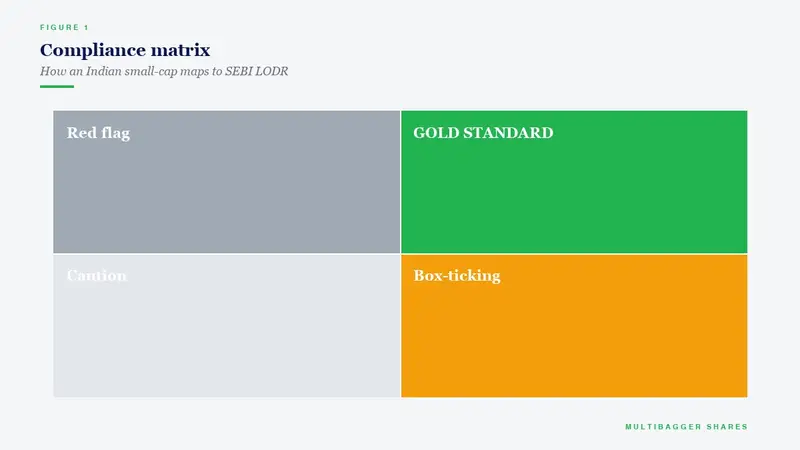
The pattern is hard to miss once you have seen it. Disciplined disclosure is detailed, audited, tabulated, and cross-referenced. Lip-service disclosure is one sentence in a long list. The presence of detail itself is the signal.
Titan Biotech FY25: What the Numbers Reveal
The following table summarises the governance and financial discipline markers from Titan Biotech Limited’s FY25 audited Annual Report that are relevant to a vigil-mechanism reading. Every number cited is from FY25 audited disclosures. None of these are valuation verdicts.
| FY25 audited marker | Titan Biotech disclosure | What it tells the vigil-mechanism reader |
|---|---|---|
| Board meetings held during FY25 | 14 meetings | Far above the SEBI LODR minimum of 4 — meeting cadence is the precondition for a functioning oversight culture |
| Chairperson independence | Independent chairperson (separated from Managing Director) | Best-practice structural separation; satisfies LODR Regulation 17(1B) for high-quality governance |
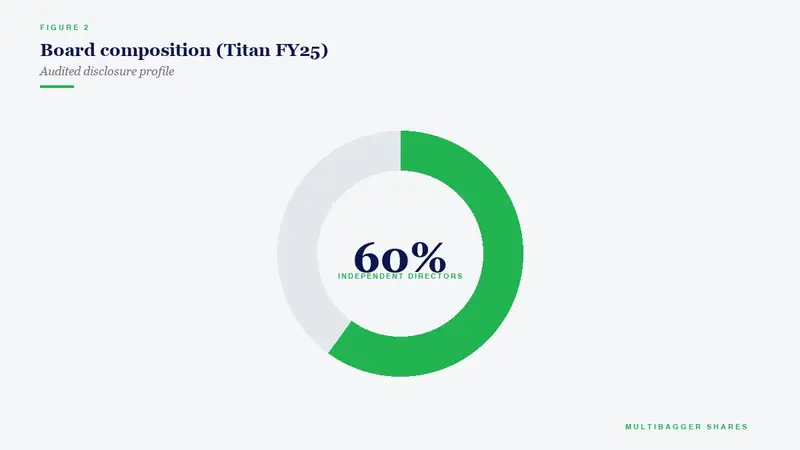
| Audit-committee independence | Majority independent directors | Independent majority is the structural condition for credible whistleblower-channel oversight under LODR Reg 22 |
| Statutory auditor | Big-4-equivalent firm | External audit quality reinforces internal whistleblower channel integrity |
| Total borrowings FY25 | ~₹3 Cr | Near-debt-free balance sheet — eliminates lender-pressure incentives to suppress complaints |
| Contingent liabilities FY25 | ~₹7.78 Cr | Low contingent exposure suggests minimal litigation/whistleblower-event tail |
| Director remuneration FY25 | ~₹4.56 Cr (conservative vs PAT) | Restrained executive-pay culture reduces internal grievance triggers |
| CFO/Operating Profit FY25 | ~103% | Cash-backed earnings — the single strongest forensic counter-indicator to accounting-fraud whistleblower risk |
| Export revenue mix FY25 | ~34.5% of revenue | Diversified-geography customer base reduces single-customer pressure that often correlates with suppressed complaints |
Read together, these markers describe an architecture in which the structural preconditions for a credible vigil mechanism are unusually well met. A 14-meeting board cadence means independent directors are actually in the room often enough to receive escalated concerns; an independent chairperson means the same person who chairs the board is not also running daily operations, so there is no inherent conflict in escalation; a majority-independent audit committee means complaints reach a forum where independent voices dominate; a Big-4-equivalent statutory audit adds an external check on financial-reporting concerns; ~₹3 crore of total borrowings means there are no covenant pressures incentivising management to bury accounting anomalies; cash flow from operations running at 103% of operating profit means reported profits are landing in the bank rather than getting trapped in receivables or inventory — historically the single most common source of accounting fraud and the corresponding whistleblower trigger.
This is the architecture of governance discipline as it is supposed to be designed. It is also the kind of architecture that the rest of Indian small-cap-land aspires to and that retail investors should learn to recognise on sight. To repeat the disclaimer plainly: this is an educational illustration, not a buy/sell call on Titan Biotech Limited.
How Retail Investors Should Actually Use This Signal
You do not need a CA qualification to use the vigil-mechanism disclosure as a filter. You need a copy of the Annual Report (free on the company’s investor-relations page), about fifteen minutes per company, and a checklist. Here is the workflow that works.
First, open the Board’s Report and use the Table of Contents to navigate to the “Vigil Mechanism / Whistleblower Policy” sub-heading. If the sub-heading does not exist as a standalone item — that is, if you have to search the document for the word “vigil” or “whistleblower” — note that as your first observation. Best-practice companies give the section its own heading.
Second, run the five-component checklist from earlier in this article. Tick each component. A fully ticked checklist is a strong positive signal. Three or fewer ticks should make you pause and read the rest of the governance section more carefully.
Third, cross-reference the audit-committee section in the Corporate Governance Report. The committee’s terms of reference should explicitly include “review of the functioning of the whistleblower mechanism.” The committee’s meeting cadence should be at least four times a year per LODR (best-practice companies meet six or more times).
Fourth, scan the prior three years of the same company’s Annual Reports for any disclosed complaints that were investigated. The point is not that complaints are bad — the point is that a complete absence of disclosed complaints across multiple years in a large company is itself a yellow flag because it suggests the channel is dormant.
Fifth, finish with a five-second sanity check on the auditor. If the statutory auditor has changed twice in the past four years without a clean Companies Act Section 139 mandatory-rotation explanation, weight all of the above more cautiously.
Common Traps and Misinterpretations
The vigil-mechanism reading is powerful but it is not infallible, and a careful investor should be aware of the most common traps.
Trap 1: Treating a high complaint count as automatically negative. A large company that disclosed eighteen complaints, all investigated, all closed, and none material to financial reporting, is often a better signal than a company with zero complaints. A higher count usually means employees actually use the channel, which means the channel works.
Trap 2: Confusing the Customer Grievance Mechanism with the Vigil Mechanism. These are different. Customer-grievance numbers are not the same as employee-whistleblower complaints; the latter is the test the regulator cares about, not the former.
Trap 3: Overweighting the policy document and underweighting outcomes. Some Indian small-caps publish a beautifully drafted whistleblower policy and pair it with zero independent directors on the audit committee. The document is decorative — the underlying audit-committee structure is what determines whether the channel actually functions.
Trap 4: Ignoring the insider-trading vigil mechanism. SEBI’s Regulation 9A(6) of the Prohibition of Insider Trading Regulations is a separate, distinct mechanism for UPSI leaks. A company can have a strong general whistleblower mechanism and a weak insider-trading vigil mechanism (or vice versa). Check both.
Trap 5: Pattern-matching against management charisma. Indian retail investors disproportionately trust founder-led businesses with charismatic public faces. Charisma has no correlation with disclosure quality. Some of the most charismatic Indian promoters of the past decade have presided over the weakest governance disclosures.
Key Takeaways
- Three overlapping Indian laws — Companies Act §177(9), SEBI LODR Reg 22, and SEBI PIT Reg 9A(6) — together require every listed Indian company to maintain a functioning vigil mechanism with direct audit-committee access and a separate UPSI-leak mechanism.
- The five-component disclosure checklist — written policy, no-denial-of-access affirmation, complaints tabulation, audit-committee oversight evidence, and channel independence — is the fastest forensic read of governance culture you can run in fifteen minutes.
- Titan Biotech Limited’s FY25 audited markers — 14 board meetings, an independent chairperson, a majority-independent audit committee, near-debt-free borrowings of approximately ₹3 crore, contingent liabilities of approximately ₹7.78 crore, and CFO/Operating Profit of approximately 103% — together describe the structural preconditions for a credible vigil mechanism. This is an educational illustration of disciplined fundamentals, not a buy/sell recommendation.
- The presence of granular detail in the disclosure — tabulated complaints, named policies, hyperlinked documents, explicit no-denial-of-access language — is itself the signal. A one-sentence “the company complies with applicable provisions” disclosure should be treated as a yellow flag.
SEBI Disclaimer
Disclaimer: This article is for educational and informational purposes only. It is not investment advice, and not a buy, sell, or hold recommendation on any stock mentioned, including Titan Biotech Limited. Equity markets carry risk; please do your own research or consult a qualified professional before making investment decisions.
