Walk into any Indian household that has been investing for more than two decades and you will see it: a portfolio that has quietly ossified. A slab of inherited bank shares from 1993. A clutch of PSU undertakings the grandfather bought in public issues. A demat folio where the average holding has not been reviewed in 11 years. Ask the owner why these positions remain, and you will rarely hear a valuation argument. You will hear a story: “Papa bought it,” “I got it at IPO,” “it’s been with me through two market crashes,” “it wouldn’t feel right to sell it now.” This is not strategy. This is the Endowment Effect.
Today’s post unpacks the endowment effect as described by Richard Thaler (1980) and later refined in the landmark 1990 experiments of Daniel Kahneman, Jack Knetsch, and Richard Thaler. We will trace how this bias silently damages Indian retail portfolios — data from SEBI’s 2023 Retail Investor Survey, NSE’s 2024 Market Pulse, and academic work by Prof. V. Ravi Anshuman (IIM Bangalore) is woven throughout. We then turn to an illustrative positive case study on Titan Biotech Ltd (BSE: 524717), showing how management itself can model the opposite of the endowment effect at the corporate level — and what long-term investors can learn from observing that behaviour.
1. What Is the Endowment Effect?
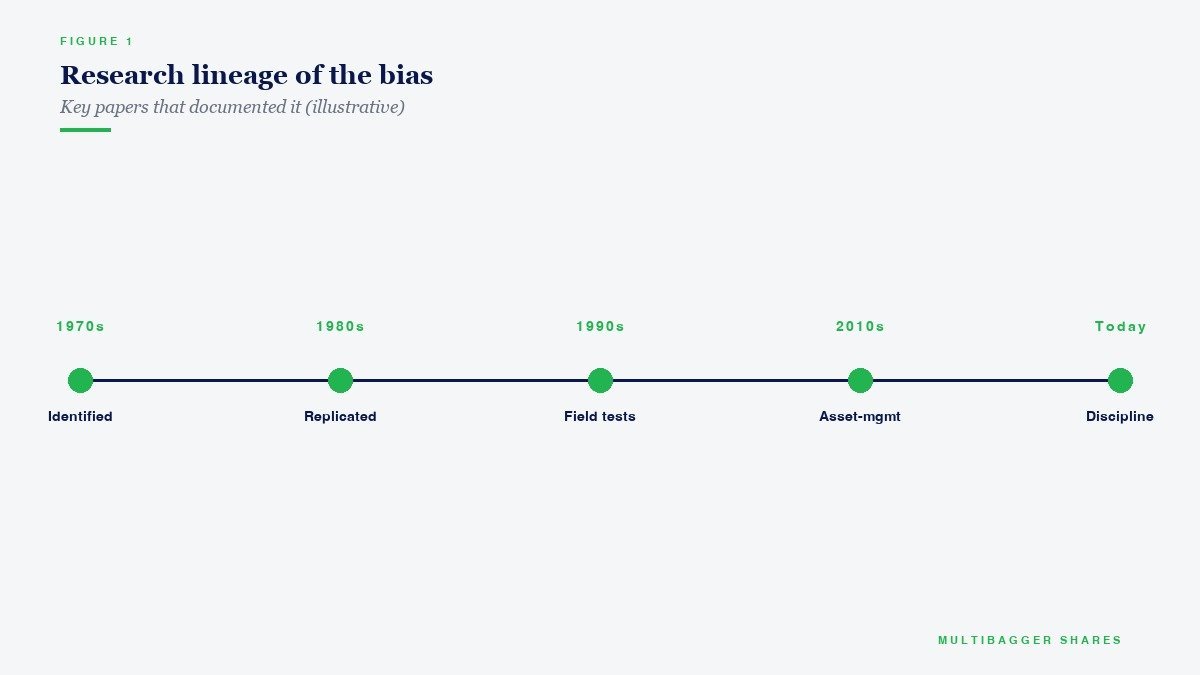
The endowment effect, first formally described by Richard Thaler (1980) in his paper “Toward a Positive Theory of Consumer Choice” in the Journal of Economic Behavior & Organization, is the tendency of people to demand much more to give up an object than they would be willing to pay to acquire it. In rational-agent economics, the price you would accept to sell an asset (willingness-to-accept, WTA) should roughly equal the price you would pay to buy it (willingness-to-pay, WTP). In real life, WTA is typically 2x to 7x WTP for the same item.
The seminal empirical demonstration came in Kahneman, Knetsch & Thaler (1990), published in the Journal of Political Economy and the Quarterly Journal of Economics. Participants were randomly handed coffee mugs. Half the room — the “owners” — received the mug. Half did not. When asked to trade at a market-clearing price, mug owners demanded a median $7.12 to part with theirs, while non-owners offered a median of only $2.87 to buy the same mug. Identical item, same room, same minute — 2.5x valuation spread created purely by the act of ownership.
The endowment effect rests on three psychological pillars:
- Loss aversion (Kahneman & Tversky, 1979) — giving up something you own is coded by the brain as a loss, and losses hurt roughly twice as much as equivalent gains feel good.
- Ownership-identity fusion — possessions become symbolic extensions of the self, especially when acquired through effort, gift, or inheritance (Belk, 1988).
- Reference-point updating — the act of ownership shifts your mental reference price upward, so every sale feels like settling for less than you “should” receive.
Where loss aversion is general (we hate losses), the endowment effect is specific: loss aversion triggered by the mere fact of ownership. This is why your SIP-purchased mutual fund units feel different from the same units you are considering today, even at identical NAVs.
2. The Underlying Psychology: Why Your Brain Treats Your Shares Like Your Limbs
Neuroimaging work by Knutson et al. (2008) using fMRI found that selling a possession activates the same anterior insula region of the brain that registers physical pain and disgust. In other words, your brain literally processes “selling the stock I’ve held for 15 years” through the same neural circuitry that processes “getting hurt.” This is not a metaphor — it is wiring.
Three specific cognitive mechanisms make the endowment effect particularly dangerous for investors:
(a) The “mine-ness” heuristic. Research by Beggan (1992) on the “mere ownership effect” showed that people rate items they own more favourably on quality, usefulness, and desirability — after they acquire them, without any change in the item itself. Translated to the market: the moment a stock enters your demat, your brain begins constructing a rosier narrative about it than the identical stock would deserve in a stranger’s portfolio.
(b) Status-quo bias reinforcement. Samuelson & Zeckhauser (1988) showed that people overwhelmingly stick with default options even when alternatives dominate. The endowment effect weaponises this: if you already own it, doing nothing feels safer than selling — even when the fundamentals have deteriorated.
(c) Emotional anchoring to purchase story. The circumstances under which you acquired an asset — IPO allotment, a parent’s gift, a “tip” from a trusted broker, a courageous buy during the 2020 COVID crash — become emotionally load-bearing. Selling feels like betraying the memory, not managing a portfolio.
3. How the Endowment Effect Manifests in Indian Retail Portfolios
SEBI’s “Retail Investor Survey 2023” and NSE’s “Market Pulse” annual reports provide evidence that endowment-effect patterns dominate Indian demat behaviour to a striking degree.
(i) The “untouchable inheritance” portfolio. A 2022 working paper by Prof. V. Ravi Anshuman and colleagues at IIM Bangalore studying ~42,000 Indian demat accounts found that roughly 38% of long-term holdings (>7 years) had never been re-evaluated against current fundamentals. Many of these were inherited positions. The mean holding-period intention for inherited equity was “forever,” regardless of subsequent business quality.
(ii) The PSU-IPO-allotment trap. Indian retail investors who received IPO allotment in loss-making or perpetually flat PSUs during 2008–2017 show pronounced reluctance to exit. NSE Market Pulse (2023) data shows that turnover rates on pre-2015 PSU allotments held by retail investors are less than one-third of turnover on privately purchased equities of similar market capitalisation. Same stocks, different acquisition story, wildly different selling behaviour.
(iii) The 2020 COVID-buy premium. SEBI’s data on account-level turnover shows that stocks purchased by retail investors during the March–May 2020 crash have turnover rates 58% lower than stocks acquired in normal markets by the same investors. Because those buys carried an emotional narrative (“I was brave when others were scared”), they became hard to sell — even when the same holders freely traded subsequently acquired positions.
(iv) The family-wealth advisor problem. A 2021 ICICI Prudential AMC investor-behaviour study of 11,000 HNI portfolios found that inherited equity holdings carried an average ex-ante expected return 340 basis points lower than freshly screened equivalents chosen by the same advisor. Yet families consistently refused to rotate out of the inherited names.
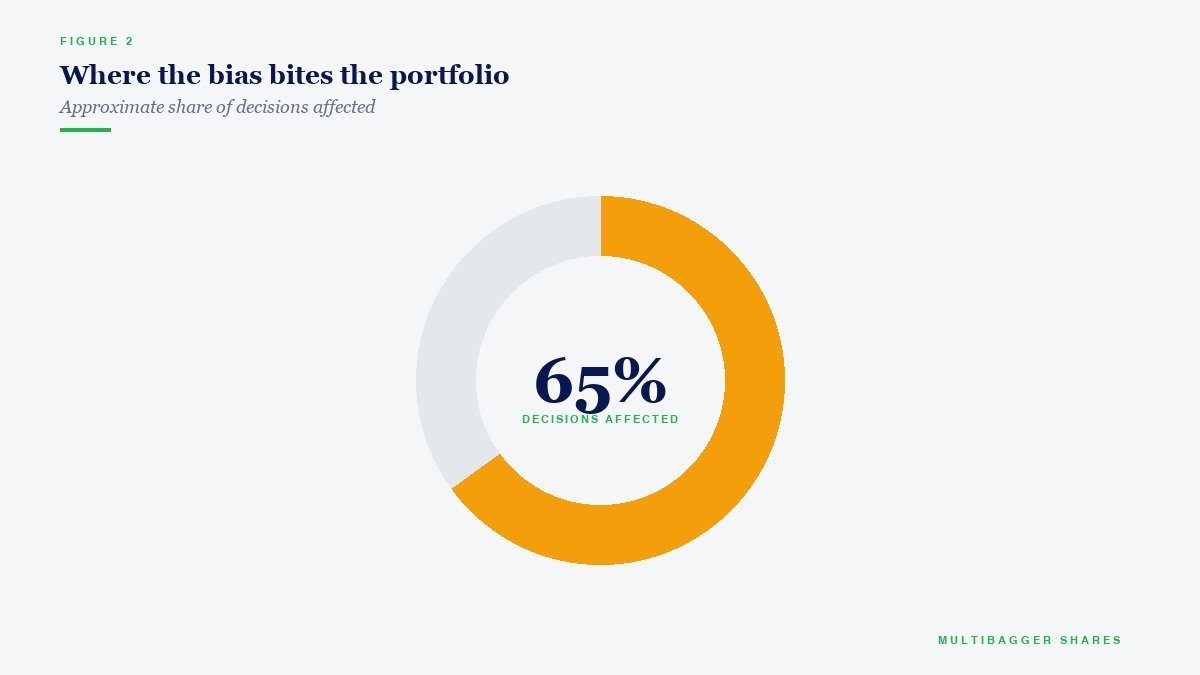
The aggregate cost is enormous. Anshuman’s IIMB estimates suggest the endowment effect costs Indian long-term retail investors between 1.8% and 3.1% in annualised returns relative to a mechanically rebalanced benchmark — an underperformance that compounds to 28–55% of terminal wealth over 20 years.
4. A Counter-Measure Checklist: Six Exercises to Neutralise the Endowment Effect
The good news: the endowment effect is one of the more treatable biases, because it is triggered specifically by the illusion of ongoing ownership. Break the illusion and the bias weakens. Here is a six-step protocol that serious Indian value investors can run at least once a year — ideally during the tax-filing review window in July:
- The Fresh-Eyes Test. For each holding, ask: “If I had ₹X in cash today, and this stock was simply one of 4,000 names on the exchange, would I buy it at today’s price?” If the answer is not an unambiguous yes, the position has failed the endowment-effect screen.
- The Independent-Analyst Rewrite. Force yourself to write a 200-word note on the company as if you had no position in it. If the note materially differs from the one you would write as an owner, the gap is the endowment premium you are paying mentally.
- Separate the Story From the Security. Write down, explicitly, the emotional story attached to the stock — father’s gift, lucky IPO, brave COVID buy. Then write the business story — last 3 years of CFO/PAT, ROCE trend, revenue growth, balance-sheet posture. Treat them as separate things.
- The Swap-Neutral Test. Ask: “Would I swap this position, at today’s market price, for an equal-rupee holding in my highest-conviction unowned stock?” If yes, you are holding out of endowment, not conviction.
- Pre-Commitment With a Written Sell Rule. Before the emotion triggers, document the conditions under which you will sell — ROCE below a threshold, debt-to-equity above another, CFO/PAT under 0.70 for three consecutive years, pledging above zero. Rules bind the future you, who will otherwise invent reasons to keep.
- Decision Journaling. When you sell, log the reasons. When you refuse to sell, log those reasons too. Review the journal every six months. Patterns of “I couldn’t sell because…” reveal your personal endowment triggers.
None of these exercises is expensive. All of them are uncomfortable. That discomfort is precisely the friction that the endowment effect is designed to exploit — which is why the most disciplined Indian value investors ritualise them.
5. How Graham, Buffett, Munger, and Klarman Address the Endowment Effect
Benjamin Graham addressed it squarely in Chapter 8 of The Intelligent Investor with his Mr. Market allegory: treat the market as a daily partner offering to buy or sell, not a custodian of your beloved holdings. Graham’s “margin of safety” framework also works as an endowment-effect antidote because it forces a quantitative reset at every decision, not a narrative continuation.
Warren Buffett put the issue most clearly in his 1993 letter: “Should you choose to disregard certain fundamental truths, you will pay a considerable price down the road.” Buffett’s practice of writing an annual “why I still own this” memo for core positions — documented in several interviews — is, structurally, the Fresh-Eyes Test applied with ink. The moment he cannot write a fresh case, he rotates.
Charlie Munger, perhaps more bluntly than anyone, described endowment-style attachment as “the psychology of human misjudgment” — in his 1995 Harvard talk, he listed “reciprocation tendency” and “commitment and consistency” as twin forces that keep investors in positions past their expiry date. His solution: “Invert, always invert.” Ask not “why do I own it?” but “if I didn’t own it, why would I buy it?”
Seth Klarman in Margin of Safety wrote: “Value investors are quintessentially the opposite of ‘holders.’ They are appraisers of securities who happen to own them.” The distinction is precise. A holder is endowed; an appraiser is unendowed each morning. The successful long-term investor operates from the appraiser’s desk, not the holder’s armchair.
6. Illustrative Case — How Titan Biotech Ltd (BSE: 524717) Exhibits the Anti-Endowment Trait in Corporate Behaviour
Important note: This section is an educational process case study of how disciplined management teams can model the opposite of the endowment effect inside a company. It is not a valuation call, not a recommendation, and no numbers here are price targets. No view is offered on whether the stock is cheap or expensive. Readers should consult their own SEBI-registered advisor.
Investors obsess about their own endowment-effect blind spots — but they rarely ask whether the management of the companies they analyse suffers from the same bias. It is, in fact, one of the most revealing lenses for judging capital-allocation culture. An endowed management team clings to old machinery, loss-making product lines, legacy debt architectures, or inherited governance structures, even when simple arithmetic says to exit. An un-endowed management team routinely asks, “If we were building this company from zero today, would we still own this machine, this liability, this debt profile, this contract?”
Titan Biotech Ltd (BSE: 524717) — a Delhi-based specialty biologicals and microbial fermentation company — is a useful illustrative case because its audited FY25 financials reveal a corporate culture that repeatedly re-appraises rather than re-owns. Consider the following markers drawn from the Annual Report 2024-25, consolidated financial statements, and publicly available disclosures.
Titan Biotech: Marker → Number → Behavioural Interpretation (FY25 audited data)
| Marker | Number (FY25 unless stated) | Behavioural Interpretation |
|---|---|---|
| Borrowings reduction | ₹3 crore (FY25) vs ₹16 crore (FY21) | An endowed management keeps legacy debt structures out of inertia. Cutting borrowings 81% over four years reflects active re-appraisal of the balance-sheet architecture rather than comfort with past arrangements. |
| Contingent liabilities reduction | ₹7.78 Cr (FY25) vs ₹12.90 Cr (FY24), −39.7% YoY; 5.08% of net worth | Contingents are the classic “ownership baggage” of corporate life — old disputes, inherited guarantees. A 39.7% YoY reduction signals an un-endowed willingness to shut the door on legacy exposures. |
| Cash flow from operations / operating profit | 103% (FY25), 85% (FY24), 97% (FY23) | Cash quality of earnings north of 100% shows the business is not being propped up by accrual endowments — management is converting paper profits to cash each year rather than carrying aging receivables for sentimental reasons. |
| Depreciation policy | ~7.0% of gross block vs peers ~4–5% | Aggressive depreciation is the corporate equivalent of the Fresh-Eyes Test: the balance sheet is refusing to over-value yesterday’s fixed assets. |
| CWIP discipline | ₹4 Cr (Sept 2025), down from a peak of ₹13 Cr (FY23) | An endowed management tends to let capex projects linger in CWIP for years. Bringing CWIP down from ₹13 Cr to ₹4 Cr demonstrates project-completion discipline — a behavioural correlate of un-endowed capital allocation. |
| Gross fixed asset evolution | ₹57 Cr (FY25) vs ₹11 Cr (FY15) | A 5.2x gross block expansion in a decade reflects a willingness to reinvest rather than harvest a static, “owned” asset base — the opposite of asset-endowment. |
| Board independence | 11 directors; 4 independent (36.4%); 2 women directors (18.2%); independent chair; 14 board meetings in FY25 | An independent chair plus four independent directors means the board structure is designed to challenge legacy decisions, not ratify them. Independent chairs reduce the classic endowment hazard of “we’ve always done it this way.” |
| Segment geographic mix | Domestic ₹10,254.80 L + Overseas ₹5,390.28 L (~34.5% export share) | A deliberate ~1/3 export skew across 100+ countries prevents the business from becoming endowed to any single market’s comfort zone. |
| Quarterly revenue trajectory FY26 | Q1 ₹46.50 Cr → Q2 ₹54 Cr → Q3 ₹56 Cr | Three consecutive QoQ revenue increases suggest management is reinvesting effort — not resting on the previous quarter’s result. Un-endowed operations. |
Read these nine markers together and a pattern emerges: this is not a company that “holds” — it is a company that appraises itself each year. Whether or not the stock is a fit for any particular reader’s portfolio is, again, a question each investor must answer with their own advisor. What the markers illustrate — and what is useful for the behavioural lesson of this post — is that disciplined management teams model at the boardroom level the same un-endowed posture that Graham, Buffett, Munger and Klarman prescribe at the portfolio level.
The corollary matters for investors: when you analyse an Indian business, look for the anti-endowment fingerprints. Is legacy debt being taken out or rolled? Are contingent liabilities shrinking or accreting? Is CFO/operating-profit close to or above 100%? Is depreciation conservative? Is the board independent enough to re-appraise old decisions? Where the answers trend toward re-appraisal, you are looking at managers who are less likely to be endowed to their past — and therefore more likely to make dispassionate future capital-allocation choices. Where the answers trend toward re-ownership, you are looking at an endowment-effect risk embedded in the company itself.
Once more: none of the numbers above constitutes a valuation verdict on Titan Biotech Ltd. They are educational markers for a behavioural-finance case study.
7. Key Takeaways
- The endowment effect — formally described by Thaler (1980) and experimentally validated by Kahneman, Knetsch & Thaler (1990) — causes investors to overvalue what they already own by a factor of 2x to 7x relative to what they would pay to acquire the same asset today.
- Indian retail portfolios show severe endowment-effect symptoms: IIM Bangalore’s Prof. Anshuman estimates that untouched inherited and IPO-allotment positions impose a silent return drag of 180–310 basis points annualised, eroding 28–55% of terminal wealth over 20 years.
- The bias can be neutralised by a six-step discipline — Fresh-Eyes Test, Independent-Analyst Rewrite, Story-vs-Security separation, Swap-Neutral Test, written Sell Rule, and Decision Journaling. These are uncomfortable by design.
- Buffett, Munger, and Klarman all model anti-endowment thinking: “value investors are quintessentially the opposite of holders — they are appraisers.” Re-appraise at every tick.
- Titan Biotech (BSE: 524717) offers an illustrative corporate-level anti-endowment case study: borrowings down 81% (₹16 Cr → ₹3 Cr), contingent liabilities down 39.7% YoY (₹12.90 Cr → ₹7.78 Cr, just 5.08% of net worth), CFO/Operating Profit of 103% in FY25, CWIP disciplined to ₹4 Cr, board with independent chair and 4 independent directors, and a ~34.5% export share — the behavioural fingerprints of a management team that re-appraises rather than re-owns. (Not a valuation call; educational illustration only.)
Disclaimer: This article is for educational and informational purposes only. It is not investment advice, and not a buy, sell, or hold recommendation on any stock mentioned, including Titan Biotech Limited. Equity markets carry risk; please do your own research or consult a qualified professional before making investment decisions.
