Friends — one small question before I begin.
There are millions of investing podcasts and YouTube channels running day and night in India. There are thousands of finance influencers repeating Warren Buffett in 90-second reels. There are books, courses, webinars, and workshops on every corner of the Indian internet. Now here is my question to you: show me the screenshots. Show me one hundred people on Twitter or LinkedIn writing “My financial life changed because of so-and-so YouTube channel.” You will not find them. Not ten. Not even five.
Now look at the other side. Numerous people who follow me have posted screenshots at my Twitter/Facebook profiles to say their financial life has changed completely. Scroll my Twitter/Facebook profiles to Know. Further, My own CAGR is in higher triple digits. Over the last 8 months, I have delivered what I believe is the highest CAGR among the roughly 20 crore Indian investors in the market. If anyone claims to have done better than me over this period, I will be the first person to stand up and publicly praise him — because beating this is extraordinarily hard, and extraordinary work deserves recognition, no matter who it comes from.
So why the asymmetry? Why does an entire content industry, many hundred times bigger than my little research shop, produce almost no life-changing outcomes? The answer is a theory I have developed and named the Information Decay Theory.
The Theory, In One Line
The value of any investment insight falls the moment too many people come to know it.
That is the whole theory. Read that line twice. If you understand it honestly, you have already understood more than 95% of the finance content industry understands about its own uselessness.
A Small Example to Make it Clear
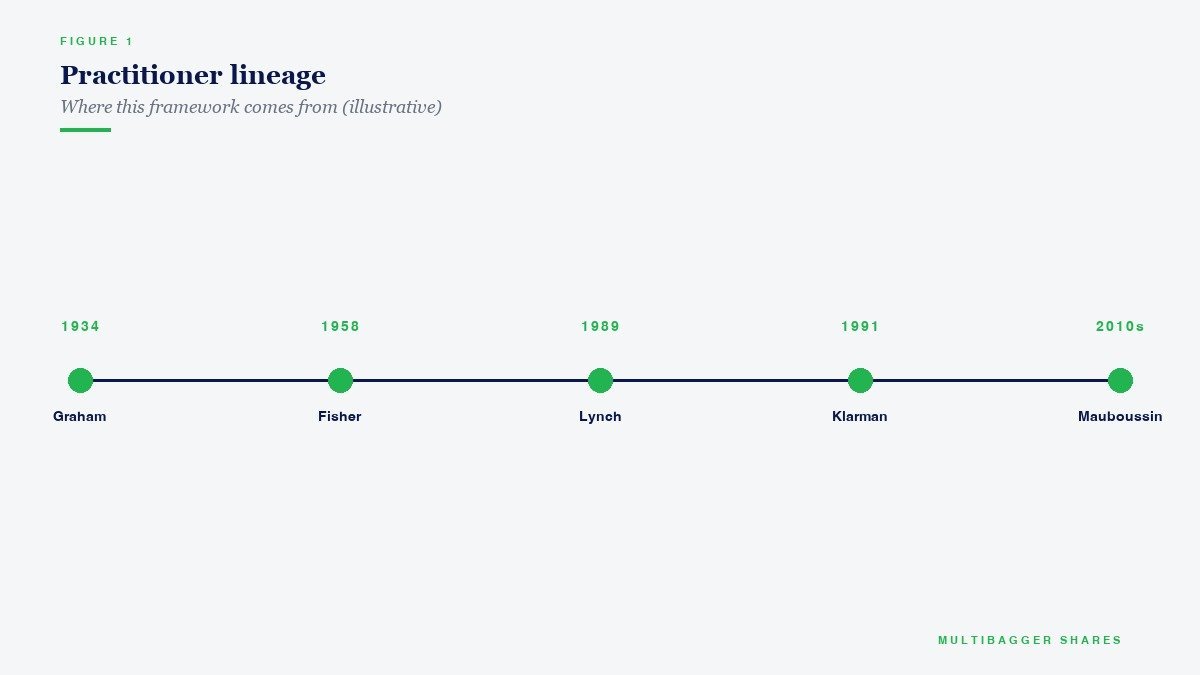
In 1934, when Benjamin Graham wrote his big book, the ideas inside it were new. Book value. Margin of safety. Buying cheap. Ninety-nine out of hundred investors in those days were just chasing tips and rumours. The few who read Graham had a real advantage, because almost nobody else had that knowledge.
Now come to 2026. Every teenager on YouTube can repeat Buffett’s famous lines. Every Instagram reel has Munger’s “invert, always invert.” Margin of safety is a first-week lesson in every online course. The ideas are still correct. But they are no longer rare. And in the stock market, a principle that is not rare is not useful.
That is Information Decay. The same line that made Graham’s early students rich cannot make today’s YouTube viewer rich. Not because the line is wrong — because it is now known to everybody.
Why The Finance Content Industry Cannot Change Your Life
A YouTube channel with 20 lakh subscribers explaining margin of safety is not doing anything wrong. The concept is correct. The delivery may even be very good. But the moment 20 lakh people receive the same insight at the same time in the same words, that insight has zero power to give any one of them an edge over the others.
This is the paradox of the crowded trade. When everyone runs to the same side of the boat, the boat does not lift — it sinks.
This is why ten years of finance YouTube has failed to change your life. Not because the content was false. Because it was heard by 20 crore other Indians at the same time as you. Your informational edge over the man sitting next to you on the train is, in plain mathematics, zero.
So What Works Then?
This is where I will say less, not more. Some of you want me to explain my method in detail. I will not. That is the whole point of this theory: the moment a method is explained on the internet, the method begins to die.
What I can tell you is this. I do not watch the same screens the 20 crore are watching. I do not read the same tweets they are reading. I do not repeat the same quotes they are repeating. I go where almost nobody else is going, I read what almost nobody else is reading, and I think in frameworks that are not available for free on YouTube.
Everything else I will keep to myself. The triple-digit CAGR is the proof. The silence is the moat.
The Indian Reality
India today has roughly 20 crore registered equity investors. Almost all of them get their principles from the same two business TV channels, the same four YouTube creators, and the same handful of WhatsApp groups. This is not an insult. It is a simple fact of the market.
When 20 crore people consume the exact same input, no subset of that 20 crore can use that input to beat the rest. The maths does not allow it. Someone, somewhere, has to be doing something different. That is the only place real returns come from, and that is the only place they have ever come from.
What You Should Take Away From This Post
Not a stock tip. Not a buy call. Not a sell call. Just one sentence, which I want you to keep in your pocket for the rest of your investing life:
If the investing principle is popular, the principle has already decayed. If the investing principle is everywhere, the profit is nowhere.
Read that again tomorrow morning. Read it again next month. Test it against every piece of finance content that arrives on your phone. You will find that it holds, every single time.
So friends, you can make money in the stock market only when you know something ‘more’ than the majority. Buffett’s principles? Every Kid on YouTube knows them.
A Closing Word — Not a Polite One
The serious Indian investor is tired. Tired of polite, spineless lectures that sound wise on camera and change nothing in real life. Stay away from those lectures. Stay away from content that everyone is consuming.
The Information Decay Theory is mine. I developed it from my own experience, on my own portfolio, with my own money at risk. I am sharing it today because I believe the Indian investor deserves at least one honest principle to stand on. What you do with it now is up to you.
— Manish Goel
Disclaimer: This article is for educational and informational purposes only. It is not investment advice, and not a buy, sell, or hold recommendation on any stock mentioned, including Titan Biotech Limited. Equity markets carry risk; please do your own research or consult a qualified professional before making investment decisions.
