Value Investing Basics
Here is a small experiment you can run this evening, and it costs nothing. Walk to the shop at the end of your lane. Ask for one particular brand of soap, or biscuit, or hair oil — by name. Then watch what the shopkeeper’s hand does.
Sometimes the hand goes straight to the shelf, picks up the thing you named, and puts it in front of you. Sometimes the hand hesitates. And then a sentence arrives: “Yeh bhi wahi hai, ye le lijiye” — this one is the same, take this instead.
That hesitation is not a small thing. It is the sound of money changing hands somewhere you cannot see. Somebody is paying that shopkeeper to make that suggestion, and somebody else is not paying him enough to keep quiet.
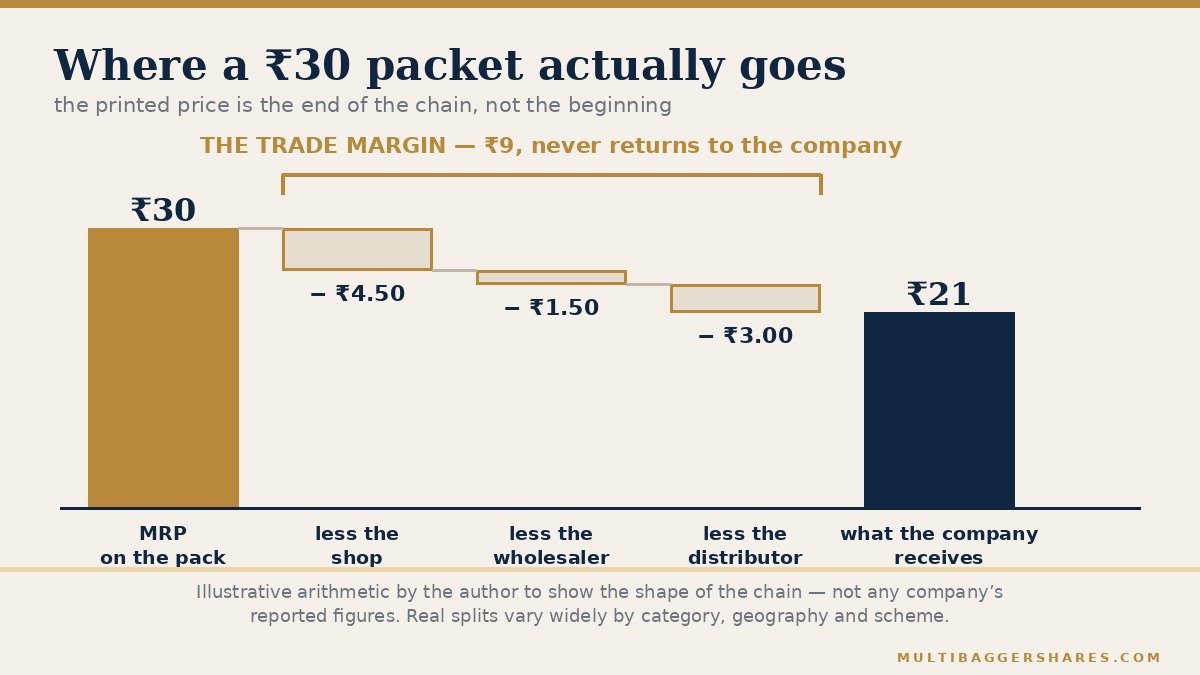
The payment has a name. It is called the trade margin (the share of the printed price that stays with the people who carry a product from the factory to your hand, and never comes back to the company that made it). It is one of the most revealing numbers in business. It is also almost invisible: you will not find it as a line in any annual report, and no industry body in India publishes it. Today, let us learn to see it anyway — and then, just as carefully, learn the four things it cannot tell you.
What the shopkeeper is actually paid
Start with the number printed on the packet. In India we call it the MRP (maximum retail price — the highest price at which a packaged item may legally be sold to you, printed on the pack itself). Most beginners read that number as the company’s price. It is not. It is the end of a chain, not the beginning.
Picture a rope stretched from a factory gate to your kitchen. The company holds one end. Along the rope stand several pairs of hands. First a distributor (a local business that buys in bulk from the company and delivers to shops in one town or district). Sometimes then a stockist or wholesaler (a middle layer that supplies smaller shops the distributor cannot reach). Finally the retailer — the kirana shop, the chemist, the supermarket. Each pair of hands keeps a piece of the rope before passing it on.
The company does not write these people a cheque. It simply sells to them at a lower price than the MRP. The effect is identical, and that is precisely why it is so easy to miss. A biscuit packet marked at thirty rupees might leave the factory at, say, twenty-one. The nine rupees in between are not the company’s profit and never were. They are the fee for four services: storage, delivery, credit (the shop pays later, the distributor waits), and — the one that matters most for us — the suggestion at the counter.
And the trade margin is only the visible half of what a shop is paid. On top of it sit the schemes: buy ten cases and get one free, an extra rupee a packet during the festival season, a payment for the best rack at eye level, an extra thirty days to settle the bill. In the trade these are called free goods, display allowance, and credit terms. To a company they are all the same thing: rent paid for space and attention.
Why a strong brand can afford to be stingy
There are only two ways to get a product off a shelf and into a bag. The trade calls them pull and push. Pull is when the customer walks in already wanting the thing and asks for it by name. Push is when the customer walks in wanting nothing in particular and the shopkeeper decides for her.
Warren Buffett described pull about as clearly as anyone ever has, in a lecture to the faculty at the University of Notre Dame in the spring of 1991. “If you walk into a drugstore,” he said, “and you say ‘I’d like a Hershey bar’ and the man says ‘I don’t have any Hershey bars, but I’ve got this unmarked chocolate bar, and it’s a nickel cheaper than a Hershey bar’ you just go across the street and buy a Hershey bar. That is a good business.”
In the same set of talks he gave the mirror image, which is the more useful half for a beginner. Walking through a supermarket in his head, he listed the shopper who will insist on Oreo biscuits, on Jello, on Kool Aid, even when the lookalike beside it is a few paise cheaper — and then stopped at the cold cabinet: “but, if you go to buy milk, it doesn’t make any difference whether it’s Borden’s, or Sealtest, or whatever.” Those are American names from a long time ago, and the brands do not matter. The behaviour does. On one shelf the customer decides. On the other the shop decides.
Now put those two shelves side by side and ask a shopkeeper’s question rather than an investor’s one. If customers walk in and demand your product by name, how much must you pay the shop to stock it? Very little — he would lose the sale to the shop across the street if he did not have it. But if nobody has heard of your product, or three near-identical products sit side by side, the shop is doing you a favour by choosing you. Favours have a price.
That is the whole idea, and it is worth reading twice. The trade margin is the price of push. A brand with genuine pull can afford to be stingy with the shop, because the customer is doing the selling. A brand without pull must buy its way onto the shelf, again and again, every single year, forever. The customer’s willingness to walk across the street is the same fact as the shopkeeper’s willingness to stock you cheaply. It is simply measured from the other side of the counter.
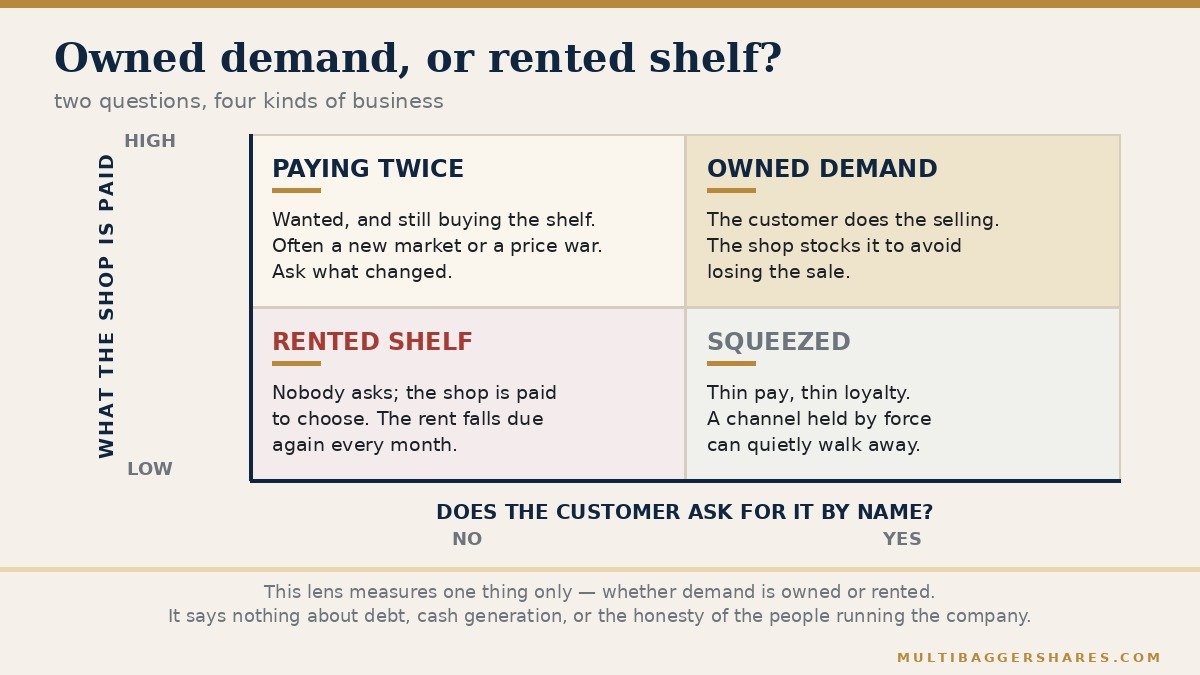
For a long-term investor that distinction is not a matter of taste. One business owns its demand. The other rents it, and the rent is due again next month.
Two shelves in India where you can actually see this
This would be a pleasant theory if the numbers were hidden everywhere. Happily, in India there are two counters where somebody has been forced to write them down.
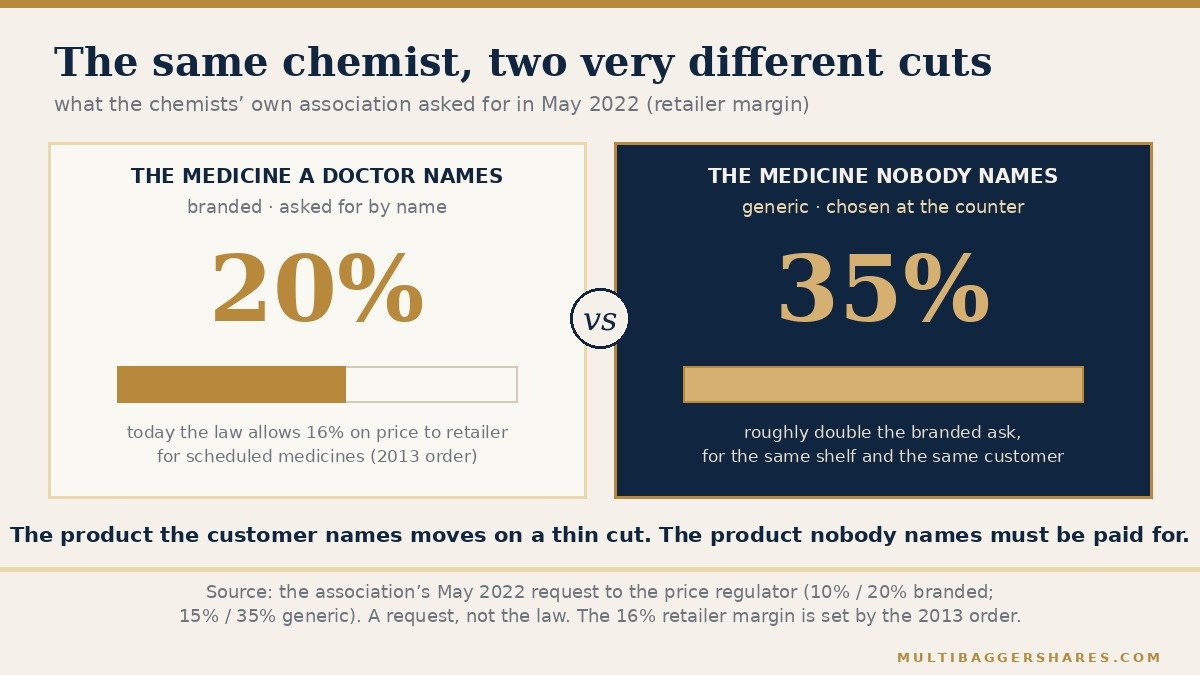
The medicine shelf. For a long list of essential medicines, the trade margin in India is not negotiated at all — it is fixed by law. The Drugs (Prices Control) Order of 2013 states plainly that “sixteen percent of price to retailer as a margin to retailer shall be allowed”. Wholesalers are widely reported to get about eight per cent. Those numbers, the chemists say, have not moved since 1997.
In May 2022 the chemists’ own national association — which by its own count speaks for roughly 9.4 lakh chemists — formally asked the price regulator to raise them, to ten per cent for wholesalers and twenty per cent for retailers. That request is unremarkable. What it asked for in the same breath is the interesting part. For generic medicines — the ones sold without a brand name, the ones no patient walks in and asks for — it asked for fifteen per cent and thirty-five per cent. Roughly double.
Read that again, because it is the entire lesson standing in one shop. Same chemist. Same shelf. Same customer. The medicine that a doctor writes down by name travels on a thin trade margin. The medicine that nobody names needs a fat one to move at all. Nobody had to prove the principle in a textbook; the trade simply priced it.
The grocery shelf. The second counter made the news very recently. On 8 June 2026 the national federation of consumer-products distributors — which says it represents more than 4.5 lakh distributors across twenty-five states — published an open letter to every large consumer-goods company in India. Its complaint was that distributor margins of three and a half to five per cent no longer cover the cost of doing the job. It asked for a revision by 30 July and warned of collective protest in August.
The letter included the federation’s own internal estimate that logistics, basic manpower and secondary transport alone swallow up to fifty-seven rupees out of every hundred, before warehousing, bank interest, compliance or damaged stock are counted at all. Treat that figure gently: it is the federation’s own assessment rather than an audited one, and the letter does not define what the hundred rupees is measured against.
The lesson here is not that distributors are underpaid, which is not ours to judge. It is narrower and more useful: the slice of the printed price that goes to the shelf is small, contested and publicly argued over. When an industry’s whole channel complains out loud, that is free information.
The money that never reaches the profit and loss account
Now for the part that surprises almost everybody, including people who have read annual reports for years. You cannot find the trade margin in the accounts. Not because anyone is hiding it — because the accounting rules require it to be subtracted before the first line is even printed.
Since 2018 Indian companies have followed an accounting standard (an official rulebook that says how a particular item must be reported) called Ind AS 115, which governs revenue. Its paragraph 51 says that the amount a company is entitled to can vary because of “discounts, rebates, refunds, credits, price concessions, incentives, performance bonuses, or other similar items”. Paragraph 70 goes further, and is the one to remember: a company must treat money payable to a customer “as a reduction of the transaction price and, therefore, of revenue”, unless it is buying something genuinely separate in return.
In plain English: when a company hands its distributors an extra scheme this quarter, that money does not appear as an expense somewhere in the middle of the profit and loss account (the statement that shows what a company earned and what it spent). It quietly reduces the very top line. Revenue simply comes in lower, and no line anywhere tells you why.
Advertising behaves in the opposite way, which is what makes the comparison so useful. Advertising is a visible expense, disclosed and discussed. For the year ended March 2026, Hindustan Unilever reported advertising and promotion spending of about ₹6,261 crore, which it described as 9.8 per cent of turnover. Marico reported about ₹1,300 crore, around 9.6 per cent of sales. Dabur reported about ₹888 crore. These are large, real numbers, and they are printed for anyone to read.
So a consumer company’s effort to be chosen comes in two halves. The pull half — advertising — is printed. The push half — what it pays the shelf — is not. Do not add them together, because you only have one of them. And do not assume the printed half is the whole story, because for many struggling brands it is the smaller half.
What can a beginner actually do with this? Watch the gap. Most consumer companies disclose volume growth (how many more units they sold) alongside revenue growth (how many more rupees came in). When revenue grows more slowly than volume for several periods in a row, and the company has not announced a price cut, something is being given away between the factory and the shelf. It may be perfectly sensible. But it is worth a question.
Four things the shopkeeper’s cut cannot tell you
A test you cannot argue against is usually a test you have not understood. Here are four honest limits.
One: the number is not published, so beware of anyone who quotes it precisely. No industry association or official source in India publishes what a kirana shop earns on a packet of biscuits. Wide ranges circulate on retail blogs and margin calculators, and they disagree with one another. The medicine numbers above are real because the law wrote them down. The grocery numbers are the trade’s own claim in a public argument. Everything else is an estimate.
Two: a fat trade margin is not always weakness. Somebody has to be paid to stock a product nobody has tried yet. A genuinely new category, a first push into small towns, a product that needs explaining at the counter — all of these deserve generous terms for a while. What matters is the direction over five years, not the level in one.
Three: a thin trade margin is not always strength. It can also be a company squeezing a channel that is quietly preparing to walk away, which is very nearly what the June 2026 letter describes. A shelf held by force is not the same as a shelf held by demand, and the difference usually shows up later rather than sooner.
Four: it tells you nothing about the balance sheet. This is the limit that catches people. A brand can be genuinely beloved, ask almost nothing of the shop, and still belong to a company carrying more debt than it can service, or run by people who take money out of the back door. The shopkeeper’s cut is a lens on one quality — whether demand belongs to the company or is rented from the trade. It is not a substitute for reading the accounts.
Five questions to ask before you decide a brand is strong
None of these needs a spreadsheet. Four of them can be answered on a walk.
1. When you ask for it by name, does the shop hand it over, or offer you something else? Ask in three different shops in three different neighbourhoods before you conclude anything.
2. Over five years, is revenue growing more slowly than volumes, without a price cut to explain it? If yes, ask where the difference is going.
3. Does the company talk about trade schemes, channel investment or consumer promotions more each year than it did the year before? Companies rarely announce that they are paying the shelf more. They do talk about it, in passing, when asked.
4. Is advertising spend rising while the shop still hesitates? Money spent on being wanted is only working if the hand at the counter stops arguing with the customer.
5. When the industry’s distributors complain in public, what does the company say back? Silence, a flat denial, and a serious answer are three very different signals about how a management thinks.
None of this will tell you what a share is worth, and it is not meant to. It is meant to help you answer a much simpler question first: is this a business whose customers come looking for it, or a business that has to go out and buy their attention back every month? Over ten or twenty years, that difference tends to show up in the accounts all by itself.
Key takeaways
- The MRP is the end of a chain, not the beginning — the trade margin is the slice of it that never comes back to the company.
- A brand people ask for by name can afford to pay the shop little; a brand nobody asks for must buy its shelf again every year.
- India’s price-control rules and the chemists’ own 2022 request show it plainly: the unnamed medicine needs roughly double the trade margin of the named one.
- Under Ind AS 115 trade schemes are subtracted from revenue before the first line, so the push spend is invisible while the advertising spend is printed.
- The test says nothing about debt, cash or honesty — it measures only whether demand is owned or rented.
— Manish Goel · multibaggershares.com
Disclaimer: This article is published by multibaggershares.com for education and general information only. It is not investment advice, investment research, or a recommendation to buy, sell or hold any security. Any companies named are discussed only as illustrative examples. Markets carry risk; please do your own research or consult a qualified professional before making any investment decision.
